Emotional Regulation
Emotional regulation is a core principle of resilience. It reflects our ability to “flexibly and productively manage our emotions.”[i] It is also a predictor of several behaviours such as reducing anxiety or anger, being able to effectively reframe a situation, conceal visible signs of fear or sadness and the ability to focus on reasons why we should feel calm or happy.[ii]
If we do not regulate our emotions, we can be prone to being overwhelmed by negative emotions which impede our ability to think clearly and, if we act in that state, can lead to regret.
We can be hijacked by our limbic system which is responsible for our flight-or-fight responses. Cortisol is released from the amygdala when we express stress or fear which can result in physiological responses that are out of proportion to the perceived threat.
If we emotionally regulate, we can defuse the hijack. In Tomorrowmind, Rosen Kellerman and Seligman suggest that if we lean in without becoming overwhelmed, we can channel the negative energy creatively.[iii] How then can we lean in and regulate?
Regulation Strategies
The following strategies are not exhaustive but can be helpful when flooded with emotion:
1. Tap into Your Physiological Responses
What is your body experiencing? For example, when angry you might experience trembling, tension, heart pounding, suffusion of heat and/or a rush of adrenalin.
Recognising the physiological symptoms may allow you to better move into strategies that work for you when seeking to regulate your emotions.
2. Breathe
Take a few slow deep breaths to lower physical arousal.[iv]
Consider trying this exercise to center yourself:
“Take 10 slow deep breaths. Focus on breathing out as slowly as possible until your lungs are completely empty – then allow them to refill themselves.
Notice the sensations of your lungs emptying. Notice them refilling. Notice your rib cage rising and falling. Notice the gentle rise and fall of your shoulders.
See if you can let your thoughts come and go as if they’re just passing cars, driving past outside your house.
Expand your awareness: simultaneously notice your breathing and your body. Then look around the room and notice what you can see, hear, smell, touch and feel.”[v]
3. Slow Down
Create a space between the triggering event and your intended response to it so that you create an opportunity to carefully choose how you want to respond.
For example:
Go for a walk – by shifting your physical environment, you can shift your mental state.
By giving yourself a green prescription, the mind has an opportunity then to “move from negative self-talk, anticipating what’s next – to discursive thought, which is slower and calmer, creative and curious …[Nature is] a sanctuary environment which calms the mind and eases the body.”[vi]
Do some other distracting task – like collecting the mail, washing dishes/stacking the dishwasher, sorting the washing in readiness for the next load.
Drop an Anchor – try this exercise to center yourself and connect with the world around you when you are caught up in your thoughts and feelings:
* “Plant your feet on the floor.
* Push them down – notice the floor beneath you supporting you.
* Notice the muscle tension in your legs as you push your feet down.
* Notice your entire body – and the feeling of gravity flowing down through your head, spine, and legs into your feet.
* Now look around you and notice what you can see and hear around you. Notice where you are and what you’re doing.”[vii]
Notice Five Things – To center yourself and engage with your environment when you are caught up in your thoughts and feelings, try this exercise:
* “Pause for a moment.
* Look around and notice five things you can see.
* Listen carefully and notice five things you can hear.
* Notice five things that you can feel in contact with your body (for example, your watch against your wrist, your trousers against your legs, the air on your face, your feet upon the floor, your back against the chair).”[viii]
When making decisions, it is always preferable to make them from a place of calm and in the absence of haste. Keep your cool!
4. Try Noticing and Naming Your Emotions
When we notice and name our emotions, we cease avoiding. The emotions lose their strength and power.
It then becomes possible to be proactive in managing them. If you are unsure of your emotions Plutchik’s Wheel of Emotions may be helpful:
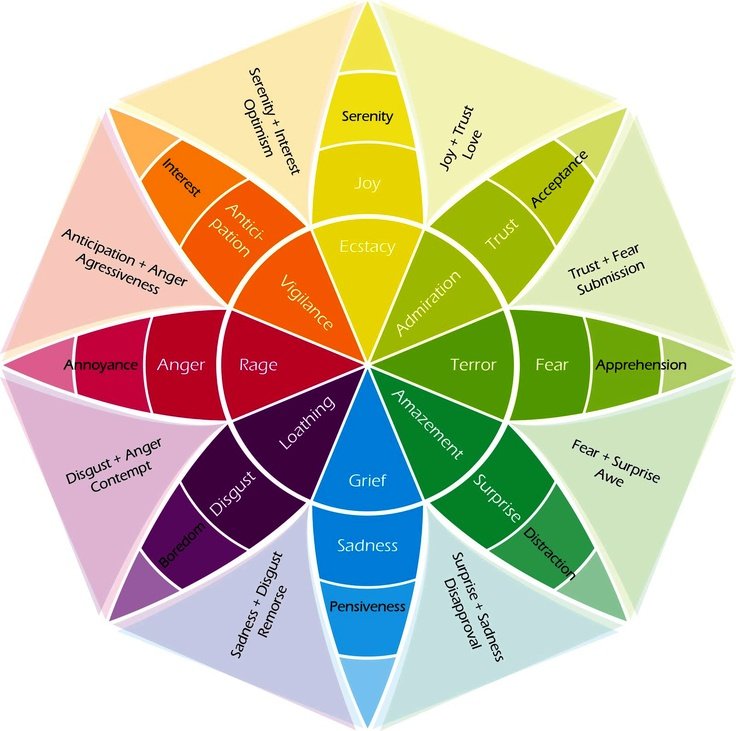
Figure 1 – Plutchik’s Wheel of Emotions
Plutchik believed that there are 8 primary emotions, represented by primary colours, that vary in intensity.
The middle of the emotion wheel reflects the maximal levels of arousal of each emotion: Grief; Loathing; Terror; Vigilance; Rage; Admiration; Amusement; Ecstasy.
The emotions further away from the centre of the emotion wheel represent milder arousal levels of the primary emotions.
Emotions placed closer to each other in the emotion wheel are deemed more similar than those farther apart.
The basic emotions are the primary ones: fear, trust, sadness, surprise, anger, disgust, joy and anticipation.
When the primary emotions are combined, they produce new emotions. For example: love = (joy+ trust); disappointment = (surprise + sadness); contempt = (disgust + anger); awe = (fear + surprise).
When noticing and naming your emotions, also ask yourself what triggered them. This not only gives you insight and builds self-awareness, it also provides a buffer between stimulus and response. There is always a choice in responding. The idea is to buy yourself enough of a buffer to make the choice that is right for you.
Taking responsibility for your choice will build self-efficacy. Subsequent self-reflection, on the choice, particularly via journalling, will clarify and enhance an understanding of the link between triggers, thoughts, feelings and actions which in turn builds emotional intelligence.[ix]
5. Validate Your Emotions
Recognise and acknowledge that your emotions are performing a valuable function. Goleman in Emotional Intelligence notes that sociobiologists believe that our emotions “guide us in facing predicaments and tasks too important to leave to the intellect alone – danger, painful loss, persisting towards a goal despite frustrations, bonding with a mate, building a family. Each emotion offers a distinctive readiness to act, each points us in a direction that worked well to handle the recurring challenges of human life. “[x]
6. Reappraise
When we reappraise, it allows for a re-evaluation and a more tempered response because, in reappraising we are stepping back from our thoughts and emotions and challenging our reactions.
In the space you have created between what has occurred and your response, ask yourself: What are the emotions telling me? What parts of the message are helpful? What parts are not? Having established this, next consider the choices you have and what information you need to make the choice that is right for you.
7. Practice Self-compassion
When we are compassionate, we engage with thoughts, urges, desires, behaviours and motives that can be directed to living things like the environment, animals or other people. This is outward facing.
When we talk about self-compassion, it is the same concept only inward facing. Self-compassion then is about self-kindness, taking time to process and reflect without using self-deprecating language.
Kristen Neff believes self-compassion has three core elements:
“Self-kindness vs self-judgement – self-compassion entails being warm and understanding to ourselves when we suffer, fail or feel inadequate, rather than ignoring our pain or flagellating ourselves with self-criticism. Self-compassionate people recognise that being imperfect, failing, and experiencing life difficulties [are] inevitable, so they tend to be gentle with themselves when confronted with painful experiences rather than getting angry when life falls short of set ideals.
Common humanity vs isolation – self-compassion involves recognising that suffering and personal inadequacy [are] part of the shared human experience – something we all go through rather than being something that happens to me alone.
Mindfulness vs over-identification – Mindfulness is a non-judgmental, receptive mind state in which one observes thoughts and feelings as they are, without trying to supress or deny them. We cannot ignore our pain and feel compassion for it at the same time. At the same time, mindfulness requires that we not be ‘over-identified’ with the thoughts and feelings so that we are caught up and swept away by negative reactivity.”[xi]
Rosen Kellerman and Seligman note that a “simple way to practice self-compassion is to imagine that whatever you are struggling with is happening to someone else.”[xii] For example, a good friend. How would you advise them? What support would you give? What emotions would you feel towards them? Then, give that all to yourself.
Self-compassion is positively associated with equanimity, optimism and positive affect. The benefits of self-compassion are numerous and include:
greater life satisfaction
greater social connectedness
greater emotional intelligence – when we attend to and understand our own feelings and our ability to regulate mood
less anxiety and depression
less fear of failure
8. Practice Mindfulness
As mentioned above, mindfulness is about being present in the moment without judgement. It is about being open and observing with curiosity in a non-judgemental way.
Emotions can be noted without over identification, without judgement and without trying to change them. This reduces their intensity. In behaving this way, you are one step removed. You are the observer.
When we practice mindfulness, we build tolerance of the more painful emotions. When this happens, the perception of threat or discomfort that might normally accompany them is reduced.[xiii]
9. Be a Problem Solver
Central to self-compassion is understanding that our problems tend to fall within the broad scope of human challenges.
To constructively problem solve, not only do we need to shift our focus and energy onto what is within our control to do something about, but we also need to clarify what the particular problem or goal is that we seek to achieve, the process to achieve the desired outcome and the ability to follow through with the process even when it is tough to do so.
Key then is identifying the underlying emotion and what you can do to address it e.g., slowing down to buy time to respond in a calm and assertive manner or practicing a breathing exercise.
10. Employ Visualisation
“Research suggests that we are more likely to perform a new behaviour if we have visualised it first.”[xiv]
If you know your triggers briefly imagine a situation that might trigger you, now visualise yourself responding in an emotionally regulated way. What does that look like for you?
When we visualise like this, research shows that many of the same parts of the brain are activated as if we perform the action.”[xv] Visualisation is a power tool in enhancing performance.[xvi]
11. Be Assertive in Your Communication
Express your emotions constructively and calmly. The aim is to get your needs and the needs of the other party met without lashing out or being emotionally volatile. In many cases, a major goal is also maintaining a good relationship with this person.
When we are assertive, we speak in a firm clear and polite manner with respect for ourselves and others.
12. Tap into Your Values
Research has shown a value is what an individual thinks is important whilst virtue is the practice of that value[xvii].
Emotional intelligence is recognising and understanding the values that influence your emotions. When we have that awareness, we can avoid overreacting and make value-based decisions. For example, if you are aware that your anger is tied to a value around respect and operating fairly then, the anger could be channelled into actions like assertive communication with the person involved rather than emotionally exploding or letting the issue fester and escalate to a point where the goal of keeping the relationship is jeopardised.[xviii]
Aligning our core values with our emotions, allows for greater resilience and emotional equilibrium.
What follows is more detailed breakdown of what a value is and what distinguishes it from a goal:[xix]
Values are described as “desired global qualities of ongoing action”[xx]. What does this mean?
Desired:
These are statements about how you want to behave, how you desire to act, what matters to you and what’s important to you.
Global qualities
This is a quality that “unites” many different patterns of action e.g., if your value is “being supportive” then there are many different actions that you might take with the quality of “supportiveness”. So key questions to ask yourself are “what personal qualities/strengths do you want to model? “How do you want to behave in your relationships?”
Ongoing action
How you want to behave or act on an ongoing basis. E.g., these may include being loving, caring, giving, sharing and contributing, being a good friend, being open and honest. They are NOT GOALS which are about what you want to get, have or complete.
Values are like a compass. A compass gives you direction and keeps you on track when you are travelling. Hence, values are a way of choosing the direction in which we want to go and to keep us on track as we travel. Goals are like things you want to achieve on your journey i.e., sights you want to see whilst travelling – they have a completion about them whilst a value is ongoing.
For Example:
1.The difference between “getting married” and “being loving”. Getting married is a goal and not a form of ongoing action. It may be capable of achievement and can be crossed off the list if achieved. Being loving is a value; it is ongoing and the idea is to behave that way for life – there is no endpoint to that way of behaving unless the value is neglected. Values are always available to us whereas goals may not necessarily be achieved.
2. To lose 10 kg of weight is a goal. To eat healthily is a value.
3. To go to the gym is a goal. Caring for your body is a value.
4. To feel happy is an emotional goal. Being warm, open and friendly towards others is a value.
Values then, are how you want to behave on an ongoing basis. They are a here and now approach – in any moment you can chose to act on them or neglect them. They are leading principles that guide us and motivate us as we move through life.
Values don’t need to be justified – values are simply statements about what is meaningful to us and don’t need to be justified.
Values may need to be prioritised – because values are available to us in any moment, we may need to prioritise which ones we draw on. E.g., If we have a value of being loving and caring to our parents but they are continually hostile and abusive to us, we may elect to cut all contact with them because our values around self-protection and self-nurture take priority.
Values are best held lightly – it is important to be aware of our values and connect with them, but you don’t want there to be rigidity, inflexibility or a sense of oppression about holding the values. They are more there to steer the course and checked in with as needed rather than clutched onto.
Values are to be freely chosen – we consciously elect to bring desired qualities to our actions. We
__________________________________________________________
References
[i] Rosen Kellerman, G., and Seligman, M., (2023). Tomorrowmind. Nicholas Brealey Publishing. London. Boston
[ii] Han Kim, Jeong, Chun J et al (2024). Emotion regulation from a virtue perspective. BMC Psychol. Jan 3; 12:11.
[iii] Rosen Kellerman, G., and Seligman, M., (2023). pg 176
[iv] Edelman, S Ph D (2013) Change Your Thinking. ABC Books. pg 105.
[v] Harris, R. (2009). ACT made simple. New Harbinger Publications, Inc. pg171
[vi] Epel, E., PhD. (2022). The Seven-Day Stress Prescription. Penguin Random House UK
[vii] Harris, R. (2009) pg 171
[viii] Ibid pg 171
[ix] Goleman, D (1995). Emotional Intelligence. Bloomsbury Publishing. pg 268
[x] Ibid pg 4
[xi] Brown, B (2021). Atlas of the Heart. Vermillion. London pg pp 138-139
[xii] Rosen Kellerman, G., and Seligman, M., (2023). Pg 76
[xiii] Edelman, S Ph D (2013) pg 380
[xiv] Ibid pg 303
[xv] Doige, N MD (2012). The Brain that Changes Itself. Scribe. Melbourne pg 204
[xvi] Ibid.
[xvii] Han Kim, Jeong, Chun J et al (2024).
[xviii] The role of value in our emotional world. June 25, 2024. The Role of Value in Our Emotional World • Psychology Town
[xix] Harris, R. (2009).
[xx] ibid